Detect AI-Hallucinated Citations
in Any Bibliography
Paste a reference list. Get every fabricated DOI, mismatched author, and invented paper flagged in minutes — not hours.
No credit card. Free daily allowance covers a typical reference list.
Why You Need an AI Citation Checker
ChatGPT, Claude, Gemini and other large language models routinely hallucinate citations — they invent papers that do not exist, attach real DOIs to the wrong articles, and silently rewrite author lists when polishing your prose. The output looks credible: real journals, plausible titles, properly formatted DOIs that lead nowhere.
The problem extends beyond manuscripts where you explicitly asked an AI to find references. A generative model may insert citations into your text even when the original task was something else entirely — a stylistic edit, an abstract polish, a methods section reworded, a conclusion tightened. Adding what looks like a scholarly citation makes the output read as more authoritative, so the model adds one. The injected reference may be a real paper attached to the wrong claim, a plausible-but-fabricated entry, or a real DOI pointing to an unrelated work. You did not ask for it, and unless you re-read the bibliography carefully against the body text, you may not notice it was added.
This is documented behaviour, not anecdote. Laban, Schnabel and Neville (2026) introduced the DELEGATE-52 benchmark across 52 professional domains and reported that even frontier models — Gemini 3.1 Pro, Claude 4.6 Opus, GPT 5.4 — corrupt an average of 25% of document content by the end of long delegated workflows, characterising the failure mode as "sparse but severe errors that silently corrupt documents, compounding over long interaction" (arXiv:2604.15597). Earlier work by Walters and Wilder (2023), in Scientific Reports, quantified the citation-specific case directly: a majority of ChatGPT-generated bibliographic references were either entirely fabricated or contained errors significant enough to mislead a reader who did not check (doi.org/10.1038/s41598-023-41032-5).
Two implications for anyone working with AI-touched manuscripts: first, the corruption is silent — the document still reads cleanly, the citations still look formatted. Second, it is statistical, not deterministic — you cannot tell by inspection whether this particular reference list was affected. The only reliable defence is to verify each entry against an authoritative source.
Manually checking 30–50 references takes 1–2 hours per manuscript. AiCitationChecker does the same job in under two minutes by cross-referencing every entry against CrossRef and OpenAlex — the canonical academic databases — and flagging exactly which references are fabricated, mismatched, or silently altered.
1. Paste Your Reference List
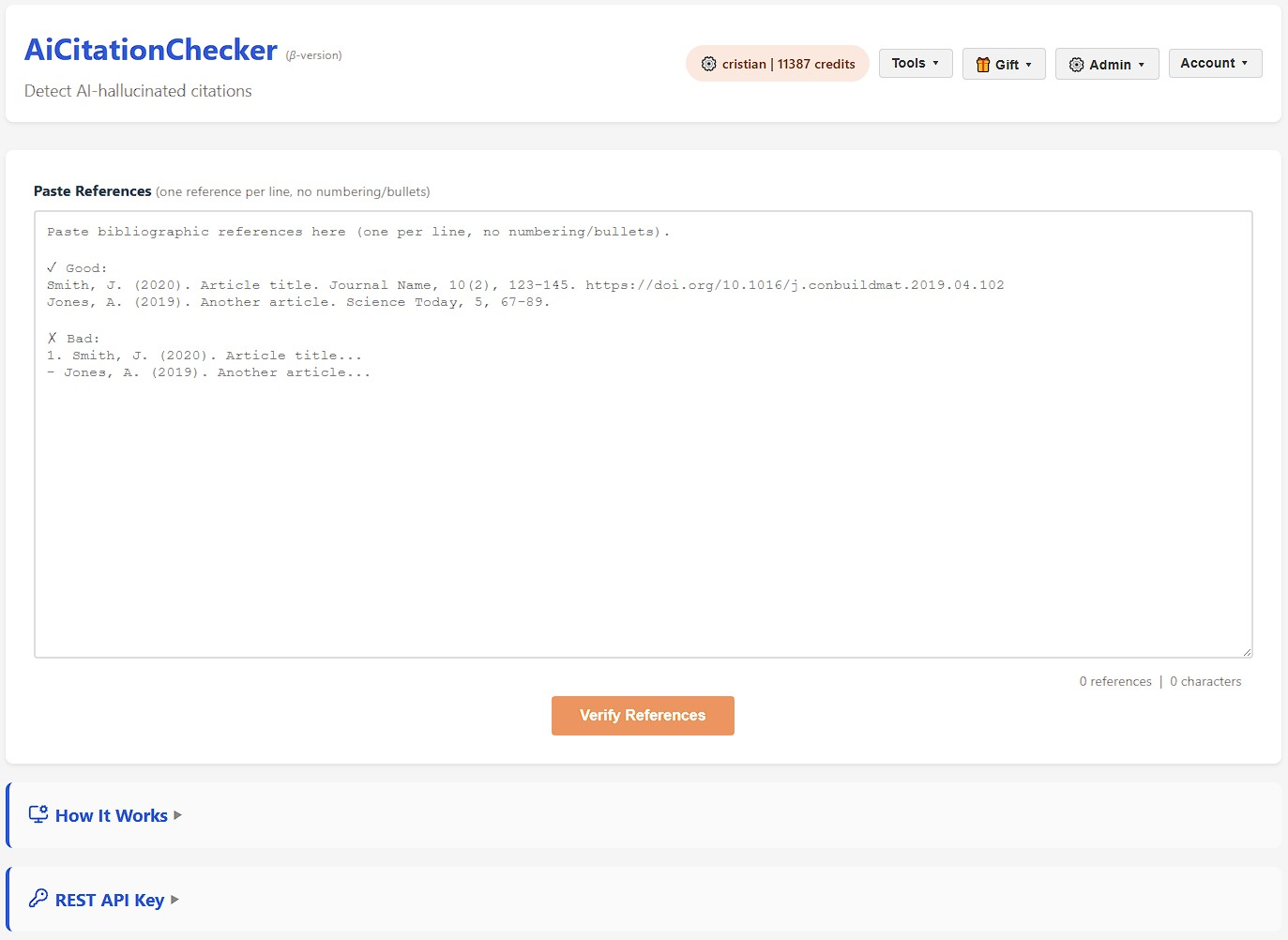
Drop in any bibliography — APA, IEEE, Vancouver, Chicago, Harvard, MDPI, ACS, Wiley/AMA, or numbered/bulleted lists exported from Word, Mendeley, Zotero, EndNote, or directly from a journal article. The tool auto-strips numbering, bullets, and "View / Web of Science®" footer noise. One reference per line, or paste a whole References chapter — the format detector handles both.
2. Format Is Detected Automatically
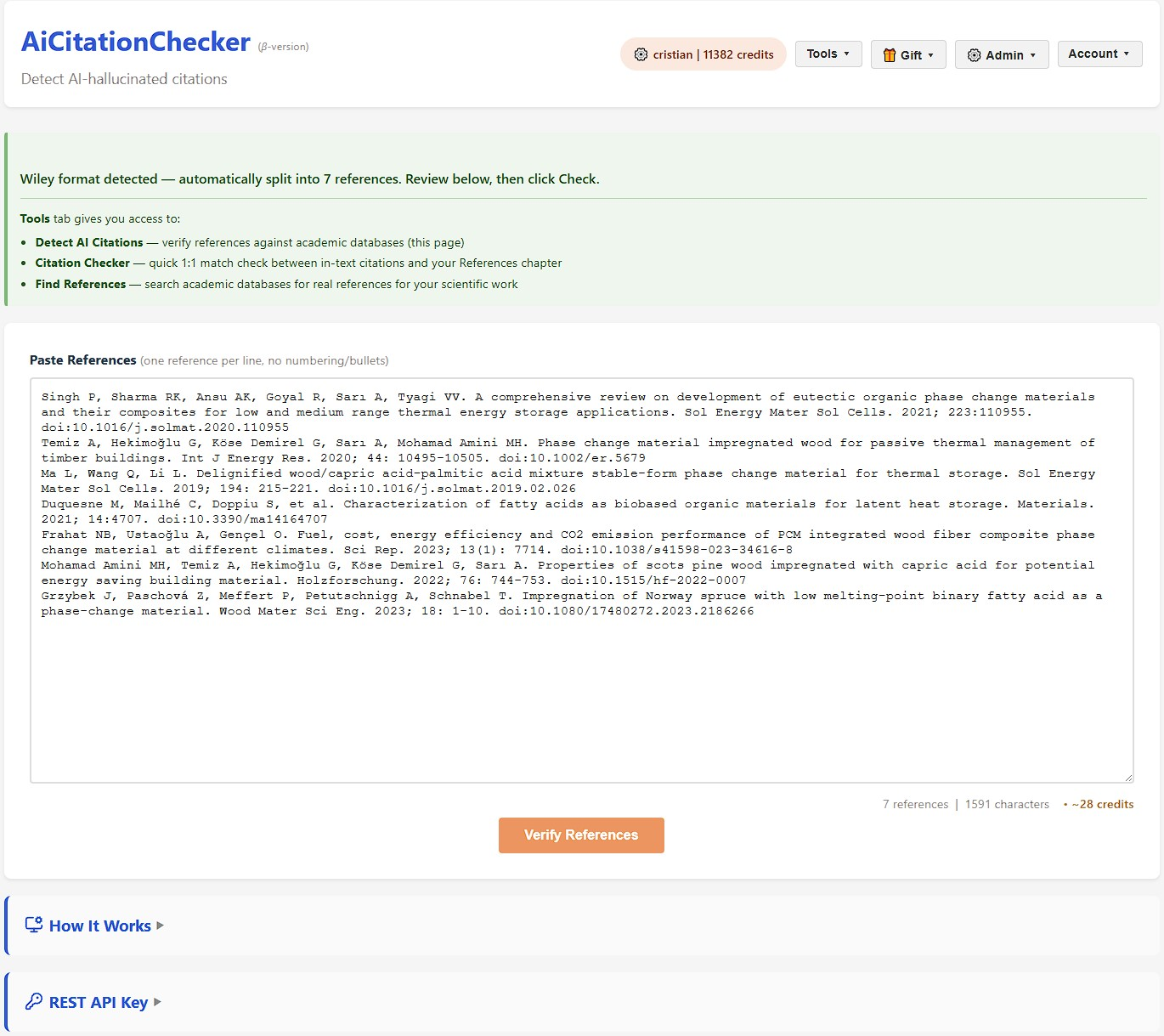
The parser recognises numbered references, bullet lists, and styles where one reference spans multiple lines (Wiley AMA, IEEE numbered). It collapses noise lines like "View" or "Web of Science®" automatically, then shows you the cleaned list and the credit estimate before you commit. Nothing is verified until you click — review the split first.
3. Get a Verdict on Every Reference
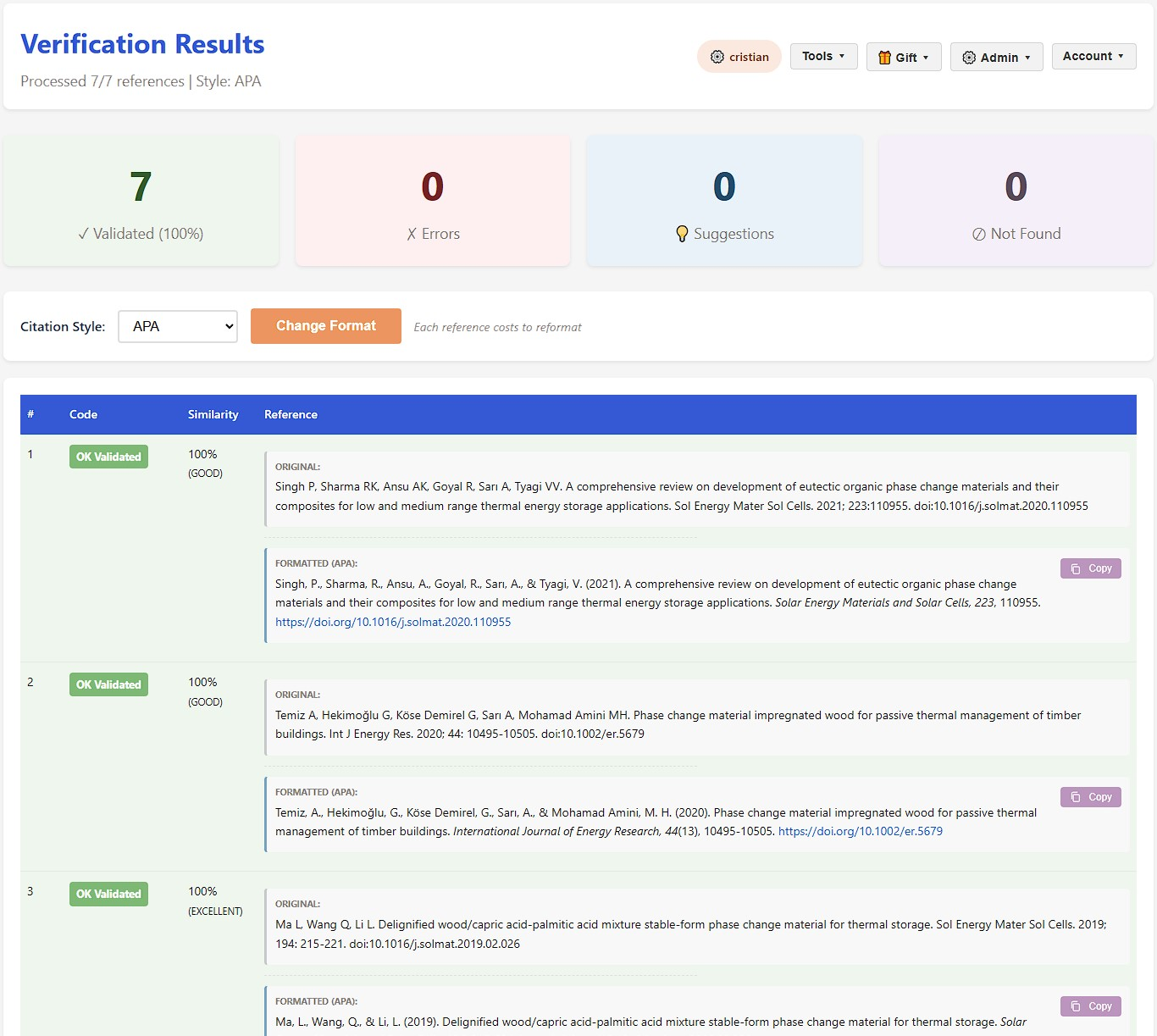
Each reference comes back with a status code (Validated, Suggestion, Error, Not Found), a similarity score against the matched CrossRef record, and a side-by-side view: your version on top, the authoritative version below. When the correct paper is identifiable, the tool also reformats the citation cleanly in your chosen style — APA, IEEE, Chicago, Harvard, Vancouver, or MDPI — and lets you export the whole verified list as a Word document.
What the Tool Catches
- Non-existent papers — no match in CrossRef or OpenAlex despite plausible-sounding metadata. The classic ChatGPT hallucination.
- DOI exists, wrong paper — the DOI resolves, but to a completely different publication. Silent corruption from AI rewriting.
- Correct title, fabricated authors — the paper is real; the listed authors did not write it.
- Real paper, wrong journal or year — metadata inconsistencies that pass a superficial visual check.
- Duplicated references — the same paper listed twice in different formats.
- Malformed DOIs — typos and invented prefixes that look plausible but resolve to nothing.
Citation Styles Supported
The detector accepts input in any common academic format and reformats verified output in your choice of:
APA · IEEE · Chicago · Harvard · Vancouver · MDPI · ACS · AMA / Wiley
Mixed-style bibliographies (a common artefact of AI-edited drafts) are handled — each reference is parsed independently.
See a Real Verification — Try It With This Snippet
Below is a raw bibliography snippet pulled from a published Wiley review article on phase-change materials in timber buildings (est2.568, Energy Storage, 2024). It is copied verbatim from the journal page — including the Wiley numbering (21–27) and the trailing "View / CAS / PubMed / Web of Science® / Google Scholar" noise lines that you would get from any Wiley copy-paste.
Copy the block, paste it at aicitationchecker.org, and click Verify. The auto-detector strips the numbering and noise lines, splits the 19 raw lines into 7 references, and runs them against CrossRef. Estimated cost: 7 × 1 = 7 credits — well within the free daily allowance, because every reference already carries a DOI (1 credits per DOI lookup, no LLM fallback needed).
21Singh P, Sharma RK, Ansu AK, Goyal R, Sarı A, Tyagi VV. A comprehensive review on development of eutectic organic phase change materials and their composites for low and medium range thermal energy storage applications. Sol Energy Mater Sol Cells. 2021; 223:110955. doi:10.1016/j.solmat.2020.110955
View
CAS
Web of Science®
Google Scholar
22Temiz A, Hekimoğlu G, Köse Demirel G, Sarı A, Mohamad Amini MH. Phase change material impregnated wood for passive thermal management of timber buildings. Int J Energy Res. 2020; 44: 10495-10505. doi:10.1002/er.5679
View
Web of Science®
Google Scholar
23Ma L, Wang Q, Li L. Delignified wood/capric acid-palmitic acid mixture stable-form phase change material for thermal storage. Sol Energy Mater Sol Cells. 2019; 194: 215-221. doi:10.1016/j.solmat.2019.02.026
View
CAS
Web of Science®
Google Scholar
24Duquesne M, Mailhé C, Doppiu S, et al. Characterization of fatty acids as biobased organic materials for latent heat storage. Materials. 2021; 14:4707. doi:10.3390/ma14164707
View
CAS
PubMed
Web of Science®
Google Scholar
25Frahat NB, Ustaoğlu A, Gençel O. Fuel, cost, energy efficiency and CO2 emission performance of PCM integrated wood fiber composite phase change material at different climates. Sci Rep. 2023; 13(1): 7714. doi:10.1038/s41598-023-34616-8
View
CAS
PubMed
Web of Science®
Google Scholar
26Mohamad Amini MH, Temiz A, Hekimoğlu G, Köse Demirel G, Sarı A. Properties of scots pine wood impregnated with capric acid for potential energy saving building material. Holzforschung. 2022; 76: 744-753. doi:10.1515/hf-2022-0007
View
CAS
Web of Science®
Google Scholar
27Grzybek J, Paschová Z, Meffert P, Petutschnigg A, Schnabel T. Impregnation of Norway spruce with low melting-point binary fatty acid as a phase-change material. Wood Mater Sci Eng. 2023; 18: 1-10. doi:10.1080/17480272.2023.2186266
Already ran? See the full verification result for this exact snippet → (7/7 validated, 100% similarity, with formatted APA output for each entry).
Who Uses It
Researchers writing manuscripts
Verify your AI-assisted literature review before submission. A clean bibliography reflects the quality of the work.
Peer reviewers
Run the reference list before your evaluation. Fabricated citations become documented findings, not opinions.
Thesis examiners
Check the bibliography before the defence. Hallucinated references are objective, verifiable facts.
Journal editors
First-pass screening at intake. Desk-reject manuscripts with fabricated references before they consume reviewer time.
Students and PhD candidates
Catch ChatGPT hallucinations in your dissertation bibliography before your supervisor does.
Research integrity offices
Document fabricated citations as binary, evidence-based findings — unlike contested AI-text detection.
Free to Start. Priced for What It Saves.
Verifying a single bibliography manually takes 1–2 hours. At any academic hourly rate, the tool pays for itself on the first use.
Free — $0
Daily credit allowance — enough for a typical reference list. Refreshed every day. No credit card, no subscription.
Silver — $9.99
90 days of Regular access + 2,500 credits. One-time purchase, no auto-renewal. Covers dozens of full reference lists.
Gold — $19.99
180 days of Regular access + 6,000 credits. For sustained high-volume use.
Related Tools
For Academics →
How peer reviewers, thesis committees and editors use AiCitationChecker to recover hours per manuscript.
For Students →
Catch hallucinated citations in your thesis or dissertation before submission.
Bibliography Checker →
The same engine, framed for full bibliography verification workflows.
30 seconds to set up. 2 minutes to check a reference list.
Free account. No credit card.
Start Free Verification