AI Citation Hallucinations
and How to Catch Them
AI writing tools invent references that look perfect but lead nowhere — fabricated DOIs, wrong authors, papers that never existed. Here is what they are, why they now carry real stakes, and how to check any bibliography in minutes.
No credit card. Free daily allowance covers a typical reference list.
What Is an AI Citation Hallucination?
A hallucinated citation is a reference generated by an AI system that does not correspond to any real, verifiable publication. It may be an entirely invented paper, a genuine title attached to a fabricated DOI, or a real article credited to authors who never wrote it. The output looks credible — real journal names, plausible titles, properly formatted DOIs — which is exactly why it slips past a quick visual check.
Large language models such as ChatGPT, Claude and Gemini produce these because they are built to generate statistically plausible text, not to perform database lookups. Asked for "three papers on a topic," a model assembles references that look like what such papers would look like. It is performing text completion, not retrieval.
The risk is not limited to cases where you asked an AI to find sources. A model can also insert a citation while doing something else entirely — polishing an abstract, rewording a methods section — because adding a reference makes the text read as more authoritative. You did not ask for it, and unless you re-check the bibliography against the body text, you may not notice it was added.
It's a Documented, Large-Scale Problem
This is measured behaviour, not anecdote. Several peer-reviewed studies now quantify it:
- Walters & Wilder (2023), in Scientific Reports, found that a substantial share of ChatGPT-generated bibliographic citations were fabricated or contained errors significant enough to mislead a reader who did not check them (doi.org/10.1038/s41598-023-41032-5).
- Topaz and colleagues (2026) reported a reference-integrity audit spanning 2.5 million biomedical papers in The Lancet, identifying fabricated citations across the literature and a rising trend over time (doi.org/10.1016/S0140-6736(26)00603-3).
- Resnik & Hosseini (2026), in Accountability in Research, argue that hallucinated citations may constitute research misconduct when they function as data — for example in systematic reviews — and the author fails to verify the AI's output (doi.org/10.1080/08989621.2026.2645390). Whether such a lapse rises to misconduct turns on the legal standard of recklessness — distinct from mere negligence — which Caron et al. (2025) examine in detail (doi.org/10.1080/08989621.2023.2256650).
Beyond academia, the same failure mode is visible in the courts: a public database maintained by legal researcher Damien Charlotin documents more than 1,500 legal decisions in which generative AI produced fabricated citations (Charlotin, 2026). Those are court filings — a domain outside the academic databases used here — but the pattern is identical.
Every peer-reviewed study cited above was checked through AiCitationChecker before publishing this page — fitting, for an article about unverified citations.
Why the Stakes Just Rose
Scientific platforms have started treating careless AI use as an actionable problem. In 2026, the preprint server arXiv announced stricter enforcement holding authors responsible for unchecked AI output — including hallucinated references — a shift widely reported across the scientific and technology press. The policy is not anti-AI; it encodes a principle that was always implicit: authors are responsible for everything in their paper, however it was generated.
The practical consequence is that a single fabricated reference is no longer a harmless slip. It can trigger a desk rejection, an integrity review, or a correction — and, because citations propagate, a fabricated reference cited once can seep into later papers and reviews. Verifying your bibliography before submission has moved from good hygiene to basic risk management.
Coverage Varies by Field — So Test on Your Own References
No verification tool can cover every discipline equally. Checking a reference means matching it against scholarly databases such as CrossRef and OpenAlex, and their coverage varies by field — strong for journal articles with DOIs, thinner for some books, chapters, and niche venues. Results can therefore differ depending on what you work on.
That is exactly why every AiCitationChecker account includes free daily checks: run your own references, in your own field, and see how the tool performs before you rely on it — or pay for anything. We would rather you confirm it fits your work than take our word for it.
See It Catch Hallucinated Citations
Paste a reference list and each entry is checked against the scholarly databases, one per line:
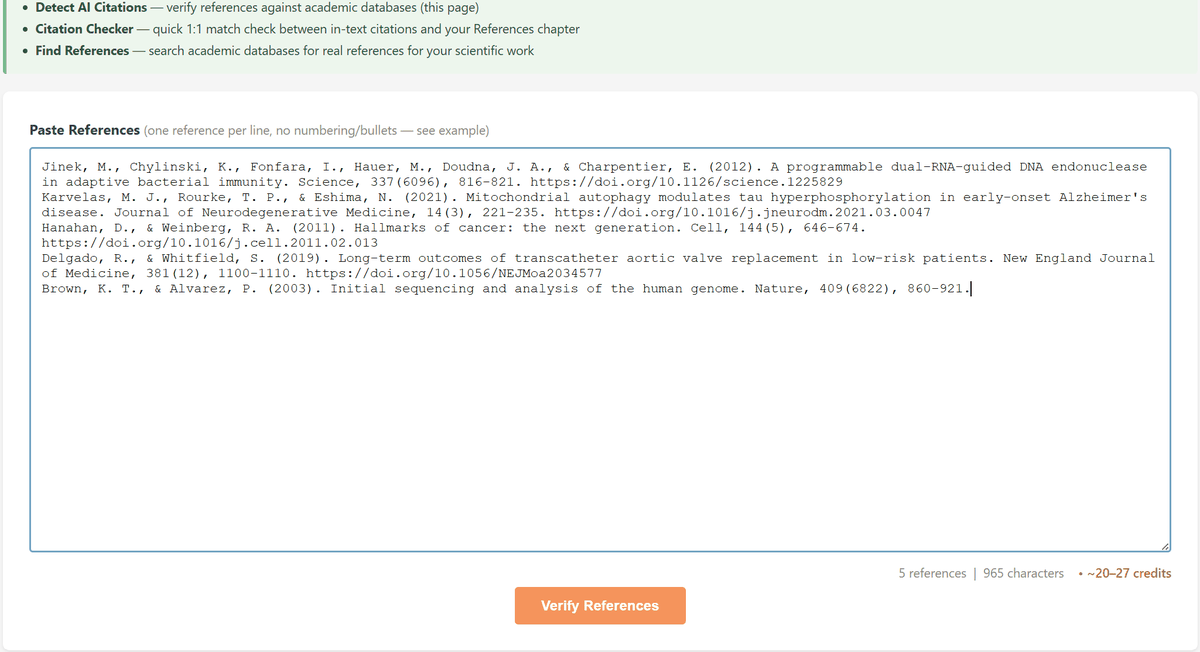
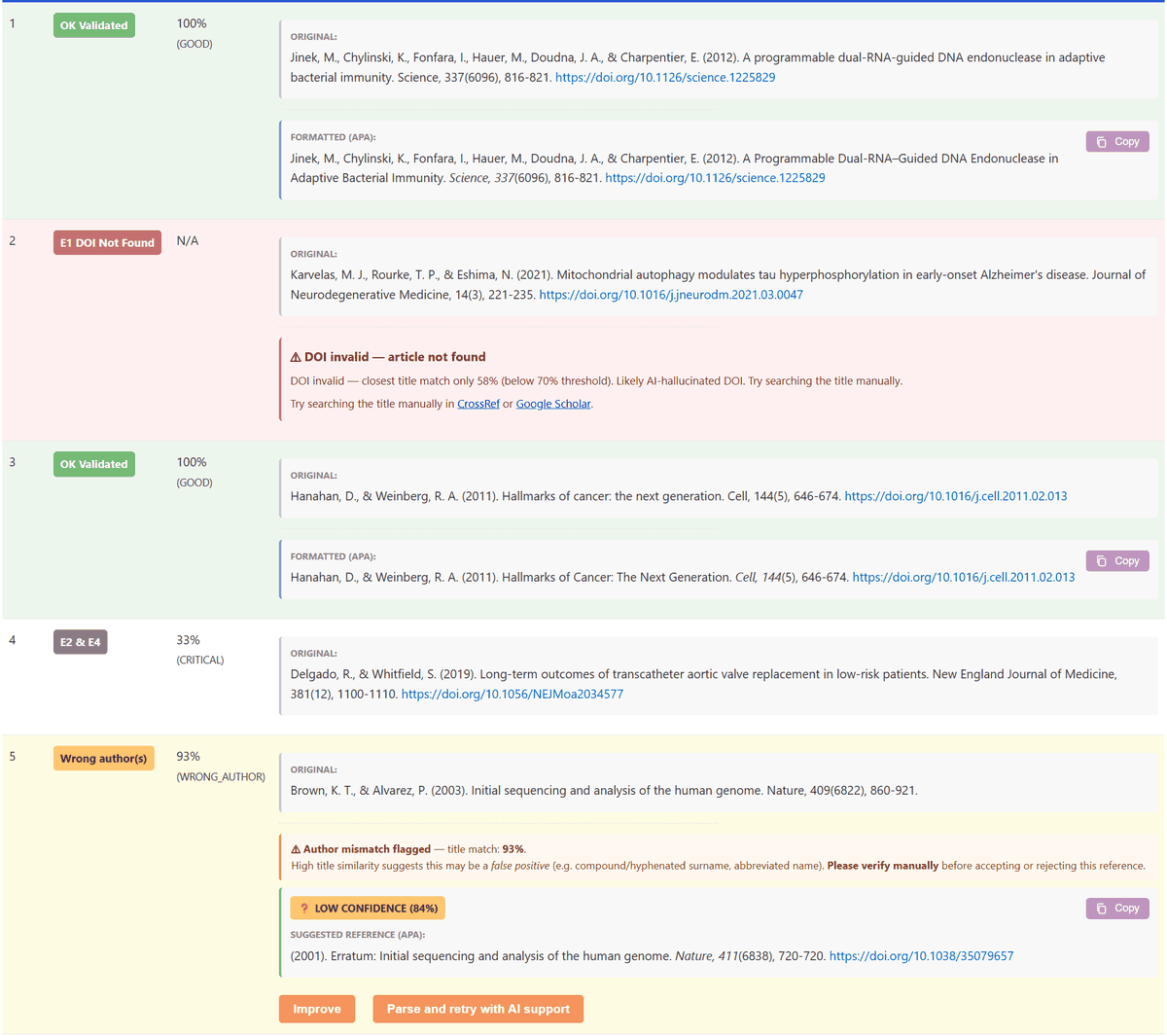
The example below mixes two genuine, well-indexed papers with three fabricated ones — of the kind AI tools produce. AiCitationChecker validated the real references and flagged each fabrication with the specific problem: an invalid, likely AI-hallucinated DOI; a DOI that resolves to a completely different paper; and a real title attached to authors who did not write it.
How to Protect Your Submissions
- Treat every AI-supplied citation as unverified until proven otherwise — a draft hypothesis, not a fact.
- Check every DOI: confirm it resolves to a paper whose title, authors and year actually match the citation.
- Cross-check against authoritative databases — a genuine paper appears in at least one of CrossRef, OpenAlex, or PubMed.
- Verify the whole reference list before submission, not just the references you knowingly asked an AI to find.
- Automate the first pass so checking is fast enough that you never skip it.
Tools That Do This For You
Detect AI Citations →
Paste any bibliography and flag every fabricated, mismatched, or invalid reference against CrossRef and OpenAlex.
Fake DOI Checker →
Catch invented DOIs and DOIs that resolve to the wrong paper — the classic AI hallucination signature.
ChatGPT Citation Checker →
Validate references drafted with ChatGPT or any other assistant before they reach a reviewer.
Check Thesis References →
Verify a dissertation bibliography before the defence — hallucinated references are objective findings.
Peer Review Checker →
Run the reference list before your evaluation; fabricated citations become documented, not contested.
For Academics →
How reviewers, editors and supervisors fold reference verification into their workflow.
Sources
Full references for the sources cited in this article:
- Walters, W. H., & Wilder, E. I. (2023). Fabrication and errors in the bibliographic citations generated by ChatGPT. Scientific Reports, 13(1), 14045. https://doi.org/10.1038/s41598-023-41032-5
- Topaz, M., Roguin, N., Gupta, P., Zhang, Z., & Peltonen, L.-M. (2026). Fabricated citations: an audit across 2.5 million biomedical papers. The Lancet, 407(10541), 1779–1781. https://doi.org/10.1016/S0140-6736(26)00603-3
- Resnik, D. B., & Hosseini, M. (2026). Hallucinated citations produced by generative artificial intelligence may constitute research misconduct when citations function as data in scholarly papers. Accountability in Research. https://doi.org/10.1080/08989621.2026.2645390
- Caron, M. M., Dohan, S. B., Barnes, M., & Bierer, B. E. (2025). Defining “recklessness” in research misconduct proceedings. Accountability in Research, 32(2), 120–142. https://doi.org/10.1080/08989621.2023.2256650
- Charlotin, D. (2026). AI Hallucination Cases [database]. https://www.damiencharlotin.com/hallucinations/
AI can draft your references. Only verification makes them trustworthy.
Check a full reference list in under two minutes. Free account, no credit card.
Start Free Verification