Your reference list, cross-checked —
before the reviewer does it for you
Paste your full manuscript — body text and REFERENCES section. Every in-text citation matched against every reference entry. Missing references, uncited entries, and ambiguous cases flagged with the exact text context you need to decide. In 20 seconds.
Free daily credits. No credit card. A 21-page article costs ~210 credits.
Why You Need a Citation–Reference Checker
Citation–reference mismatches are the most common, least visible error in academic manuscripts — and the hardest to catch manually. A spell-checker will not find them. A grammar tool will not find them. Even a careful human re-read often misses them because the eye tends to match what it expects to see.
The scale of the problem is documented in the literature itself. Eichorn and Yankauer (1987) found that 31% of references in public health journals contained errors. Evans, Nadjari, and Burchell (1990) found a 48% error rate across three medical journals. DeLacey, Record, and Wade (1985) identified quotation errors in 15% of references in six medical journals. These numbers have not improved with word processors — they have simply shifted from typographic errors to structural mismatches.
The most common structural mismatch is invisible during writing: you cite a paper by one author's name, the reference list uses a different author's name (because citation style differs from reference format), and the two entries never match on a visual scan. The paper is real; the reference is accurate; but the link between text and list is broken.
AiCitationChecker's Citation–Reference Checker does the exhaustive cross-referencing mechanically — comparing every author–year pair or numbered citation in the body text against every entry in the REFERENCES section, in under 20 seconds for a full journal article. What remains for you is a short list of flagged items, each with the exact text snippet, ready for a 2-minute human review.
~20 s
to audit a 30-page article
100%
of citations cross-checked
2–3 min
to resolve all flagged items
22 matched automatically. 7 flags. 2 minutes to clear them. That is the actual result from running the tool on a 21-page published journal article — "Fawlty Towers of Knowledge?" (Wright & Armstrong, Interfaces, 2007), a paper that studies citation errors in academic research. The tool also found a real formatting error in the paper's own reference list: two entries concatenated onto one line. See the full results →
1. Paste Your Full Document
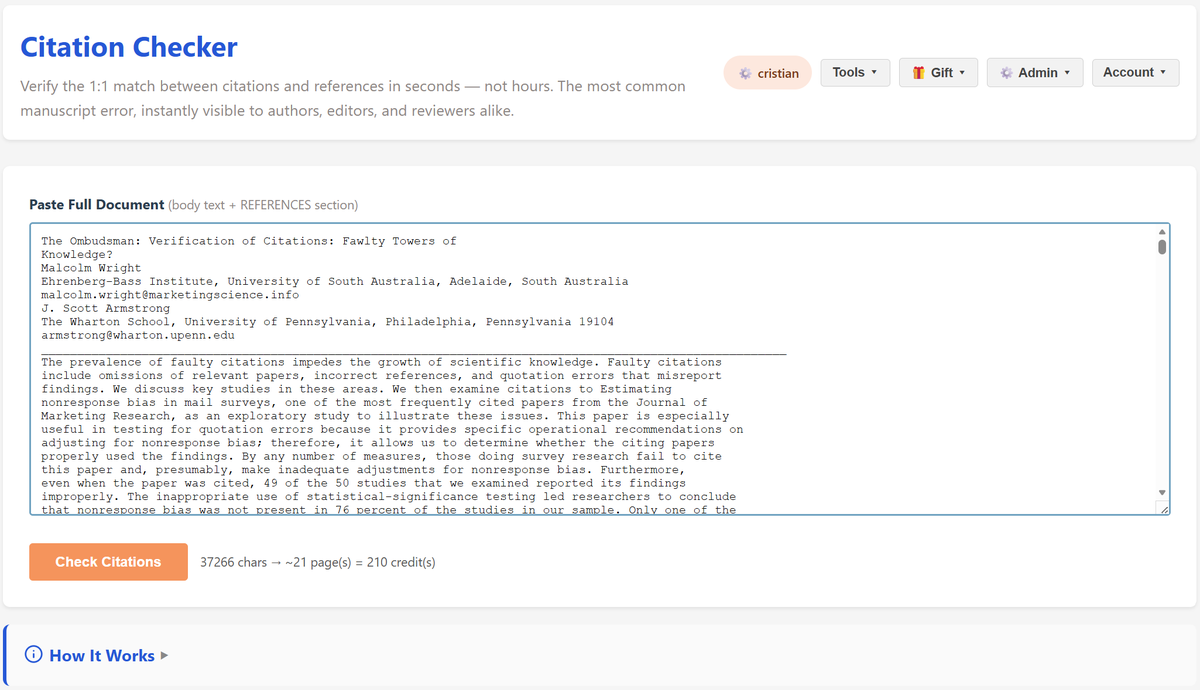
Paste the entire document — body text with in-text citations and the REFERENCES section — into a single textarea. No formatting required. The tool detects the citation style automatically (APA/Harvard/Chicago author–year, or IEEE/Vancouver numbered styles) and identifies the REFERENCES separator. The character counter shows your page count and exact credit cost before you submit.
2. The Tool Cross-References Everything
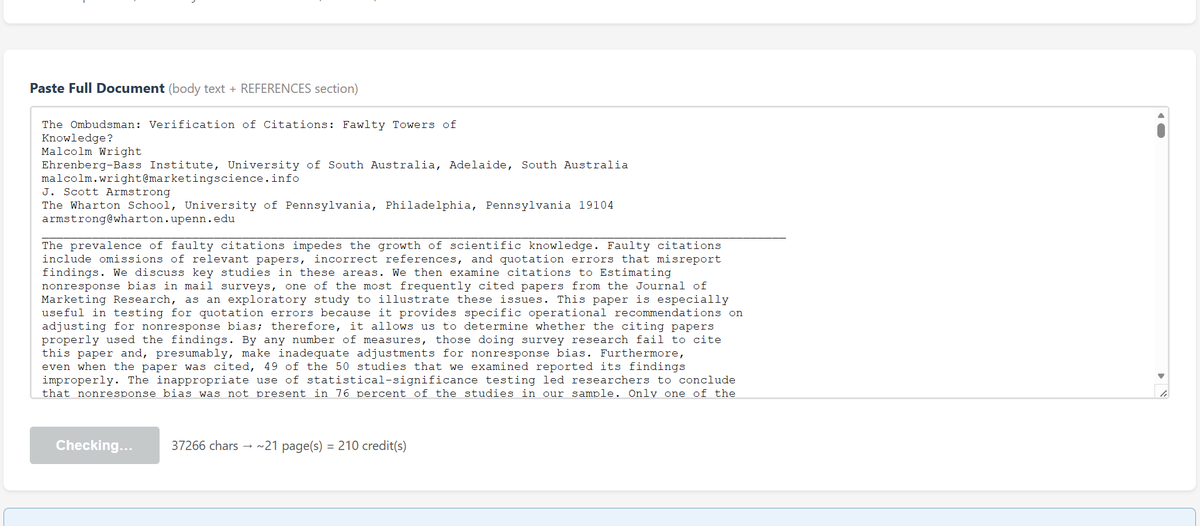
Every author–year pair extracted from the body text is matched against every entry in the REFERENCES section. The matching engine handles abbreviations, initials, multi-author groups, punctuation variations, and common formatting asymmetries. A 21-page article with 24 citations and 24 reference entries is processed in approximately 3 seconds.
3. Review a Structured Audit — Not a Wall of Text
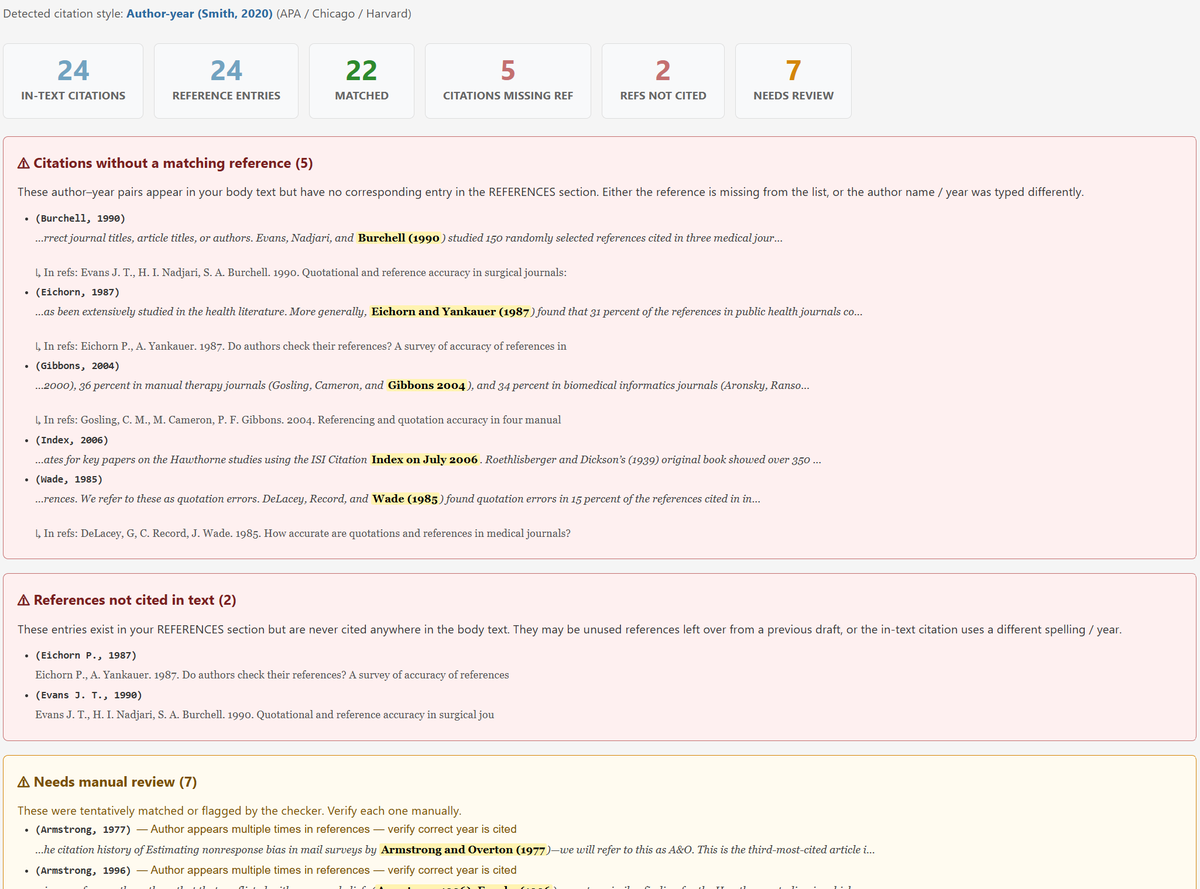
Results are grouped into four categories: Matched (confirmed 1:1 link), Citations missing a reference (in-text citation with no matching entry), References not cited in text (reference entry never mentioned in the body), and Needs manual review (tentative match flagged for human confirmation). Each flagged item includes the exact text snippet — enough context to resolve it in seconds.
The Design Principle: Machine Speed, Human Judgment
The tool is designed to flag all potential mismatches, not just the ones it is certain about. This is intentional. Consider what happens when a citation uses the third author's surname — "Wade (1985)" in the body, but the reference list reads "DeLacey, G., C. Record, J. Wade. 1985..." A purely mechanical matcher will flag this as missing. A human glancing at the snippet resolves it in three seconds.
The alternative — a tool that silently resolves ambiguous cases — would inevitably miss real errors. The cost of a false positive is three seconds of human time. The cost of a missed error is a rejection, a correction request, or a published mistake.
In practice: the typical audit surfaces 3–7 flagged items per manuscript. With the context snippets provided, a researcher resolves them all in under 3 minutes. The mechanical cross-referencing — which would take 15–30 minutes to do reliably by eye across 20+ references — is done in 20 seconds.
What the Checker Finds
- Citation in text, no matching reference entry — the reference was cited but never listed, or the author name / year was typed differently in the two places.
- Reference entry never cited in text — the reference exists in the list but is never mentioned in the body. Often a leftover from a previous draft.
- Multi-author asymmetry — text cites by a non-first author's name (common with "et al." reductions); the reference list uses a different ordering. Flagged with context so you can confirm the intended link.
- Same-author, multiple-year ambiguity — when an author has three papers in the reference list, each in-text "(Armstrong 1977)", "(Armstrong 1996)", "(Armstrong 2007)" is verified independently to ensure the correct year is cited in each location.
- Concatenated reference entries — two references accidentally merged onto one line in the REFERENCES section (as found in the Wright & Armstrong paper itself — DeLacey + Schulmeister on one line), creating a valid-looking but uncitable entry.
- Reference manager drift — a reference renamed or edited in your reference manager after it was inserted into the text; the in-text citation reflects the old version, the reference list reflects the new one. Invisible to spell-check and grammar tools.
- Duplicate citations under different keys — the same work cited twice under slightly different author strings or years, generating two reference entries for one source. Common when co-authors paste from different drafts or reference manager exports.
- Style inconsistencies — different punctuation, abbreviated vs. full journal names, or initials vs. full first names between the body citation and the reference entry.
See a Real Audit — "Fawlty Towers of Knowledge?"
The document below was used as a live test: "The Ombudsman: Verification of Citations: Fawlty Towers of Knowledge?" by Malcolm Wright and J. Scott Armstrong, published in Interfaces (INFORMS), 2007. It is available open-access at mpra.ub.uni-muenchen.de.
The article was chosen deliberately: it studies citation errors in academic research — the exact problem the checker solves. It has 24 in-text citations and 24 reference entries, in author–year (APA/Harvard) style, across 21 pages. A self-referential, near-perfect test case.
Results in 3 seconds (210 credits):
22
Automatically matched
5 + 2
Flagged (missing ref / uncited)
7
Needs manual review
The 5 "Citations missing a reference" all resolve within seconds: four are cases where the text cites by a non-first author's name (Burchell, Eichorn, Gibbons, Wade — each is the second or third author of a multi-author paper), and one is "Index, 2006" — a reference to the ISI Citation Index database, not a paper. The tool flags them; a human confirms them in under 2 minutes.
The 7 "Needs manual review" cases are all authors with multiple papers in the reference list (Armstrong, Franke, MacRoberts). The tool correctly asks: of the three Armstrong papers (1977, 1996, 2007), which year does each in-text "(Armstrong, 1996)" point to? The answer is unambiguous from the snippet — but the machine flags it so you confirm.
The real error found: The DeLacey (1985) reference entry in the paper's own REFERENCES section is concatenated with the beginning of Schulmeister's reference — two papers merged onto the same line. This is a real formatting error in a published paper about citation errors. The irony is complete.
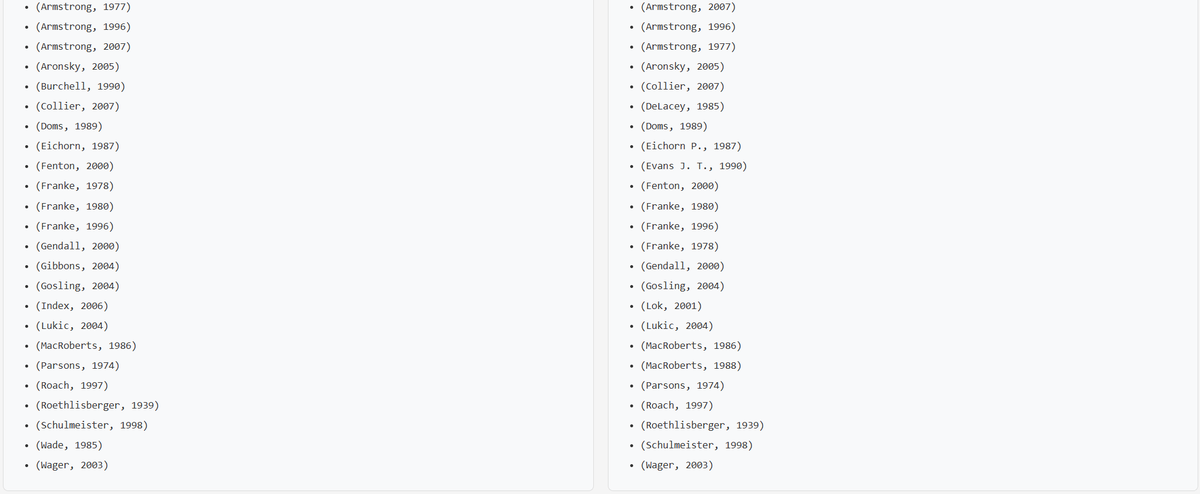
The complete side-by-side list of all in-text citations and all reference entries is always included at the bottom of the results — the fastest way to spot any remaining asymmetry with the naked eye.
Who Uses the Citation–Reference Checker
Authors before submission
The final pre-submission check that word processors cannot perform. A clean citation audit signals manuscript quality to reviewers before they read the first sentence.
Peer reviewers
Run the document through the checker before writing your review. Citation-reference mismatches become documented, objective findings — not impressions.
Journal editors
First-pass intake screening. Desk-return manuscripts with structural citation errors before they consume reviewer time. No technical expertise needed — paste and read.
PhD students and supervisors
Catch mismatches in thesis chapters before submission. A missing reference in a 200-page thesis is harder to find manually than in a journal article — the checker handles both.
Research assistants
When compiling literature reviews or editing reference lists across multiple documents, an automated cross-reference audit replaces hours of manual work.
Research integrity offices
Citation-reference mismatches are objective, binary findings. The checker produces a structured audit trail — useful in both preliminary screening and formal investigations.
Citation Styles Supported
The style is detected automatically. Both families are supported:
Author–year: APA · Harvard · Chicago Author-Date · MLA
Numbered: IEEE · Vancouver · numbered footnotes
The reference list must begin with a standalone line containing only the word REFERENCES (i.e. like a chapter title) — no additional text on that line. Capitalisation does not matter. If your list is headed Bibliography or Literature Cited, rename that one line to REFERENCES before pasting.
Free to Start. Priced by Page, Not by Subscription.
Cost: 10 credits per page (1 page = 1800 characters). A typical 20-page journal article costs 200 credits. A 50-page thesis chapter costs 500 credits. Free daily credits are refreshed every day — enough to audit a short manuscript at no cost.
The exact character count and credit cost are shown before you submit — nothing is charged until you click Check Citations.
Free — $0
Daily credit allowance, refreshed every day. No credit card, no subscription. Enough for a short manuscript or chapter.
Silver Pack
One-time credit purchase — no auto-renewal. Covers dozens of full journal articles or several thesis chapters. See current price at checkout.
Gold Pack
Higher credit volume for sustained use: a research group, an editorial office, or a high-output author. See current price at checkout.
Frequently Asked Questions
What tool checks that in-text citations match the reference list?
The Citation–Reference Checker. Paste your manuscript text (body and reference list, copied from Word or a PDF). Every in-text citation is matched to an entry in the reference list. Citations with no matching reference, and references that are never cited, are flagged with the exact sentence they come from.
Can it find references in my bibliography that are never cited in the text?
Yes. Every reference-list entry that no in-text citation points to is listed under “References not cited in text”. It works with author–year styles (APA, Harvard) and numbered styles ([1] or (1)), and recognises reference headings in several languages (References, Bibliografía, Bibliografia, Références, Literatur).
Do I need to format the document in any special way?
No. Paste your document as-is from Word, Google Docs, or a PDF copy-paste. The only requirement is that the reference list begins with its heading on a line of its own (no page numbers or other text on the same line). References, Bibliography, Works Cited and Literature Cited all work, as do the usual headings in Spanish, Portuguese, French, German, Italian and Polish.
Will it work with mixed citation styles?
The document must use one consistent style — either author–year throughout, or numbered throughout. Mixed-style documents (some citations numbered, some by author) are not currently supported.
What if the tool flags a citation that I know is correct?
Each flag includes the exact snippet from your document and the best-match candidate from your reference list. Review the snippet: if the match is correct (e.g., a multi-author citation using a non-first author's name), the flag resolves in seconds. The tool surfaces everything; you decide.
How is this different from the reference verification tool at /work?
The reference verifier checks whether your bibliographic entries are real, correctly described papers — it queries CrossRef, OpenAlex, and Semantic Scholar to verify each DOI, author, and title. The citation–reference checker verifies that your in-text citations and your reference list are consistent with each other. They are complementary: one checks the references, the other checks the links between citations and references. Together they cover the full manuscript citation audit.
Related Tools
Detect AI-Hallucinated Citations →
Verify that your reference entries are real, correctly described papers — cross-referenced against CrossRef and OpenAlex.
For Academics →
How peer reviewers, editors, and research groups use AiCitationChecker across the publication workflow.
Bibliography Checker →
The full bibliography verification workflow: format validation, CrossRef lookup, and corrected output in your chosen citation style.
20 seconds to audit a 30-page manuscript.
Free daily credits. No credit card. Paste and check.
Check My Citations Now