Is Every Citation in Your
Bibliography Real?
Paste your reference list. Every entry is checked against CrossRef, OpenAlex, and Semantic Scholar — hallucinated titles, wrong authors, and fabricated DOIs flagged in minutes, not hours.
No credit card. Free daily credits cover a typical reference list.
Why a Citation Checker, Not Just a Re-Read
A citation can be wrong in ways no spell-checker, grammar tool, or careful re-read will catch: the paper does not exist, the DOI resolves to a different article, the author list was silently altered, or the year and journal were transposed. The reference looks right — real journal, plausible title, well-formatted DOI — so the eye accepts it. Verifying it means checking each entry against an authoritative record, one at a time.
Citation error is not a rare edge case; it is documented and persistent. Eichorn and Yankauer (1987) found that 31% of references in public health journals contained errors. Evans, Nadjari and Burchell (1990) found a 48% error rate across three medical journals. DeLacey, Record and Wade (1985) identified quotation errors in 15% of references in six medical journals. Word processors did not fix this — and generative AI has made it sharper: a majority of ChatGPT-produced references are fabricated or contain errors serious enough to mislead a reader who does not check (Walters & Wilder, 2023, Scientific Reports, doi.org/10.1038/s41598-023-41032-5).
AiCitationChecker verifies mechanically — cross-referencing every entry in your reference list against CrossRef, OpenAlex, and Semantic Scholar, the canonical academic databases — and returns a verdict on each: real and correct, real but mis-described, or not found at all. A 30–50 reference bibliography that takes 1–2 hours to check by hand is done in under two minutes.
3
databases cross-checked per reference
< 2 min
to verify a full bibliography
100%
of references checked, one by one
1. Paste Your Reference List
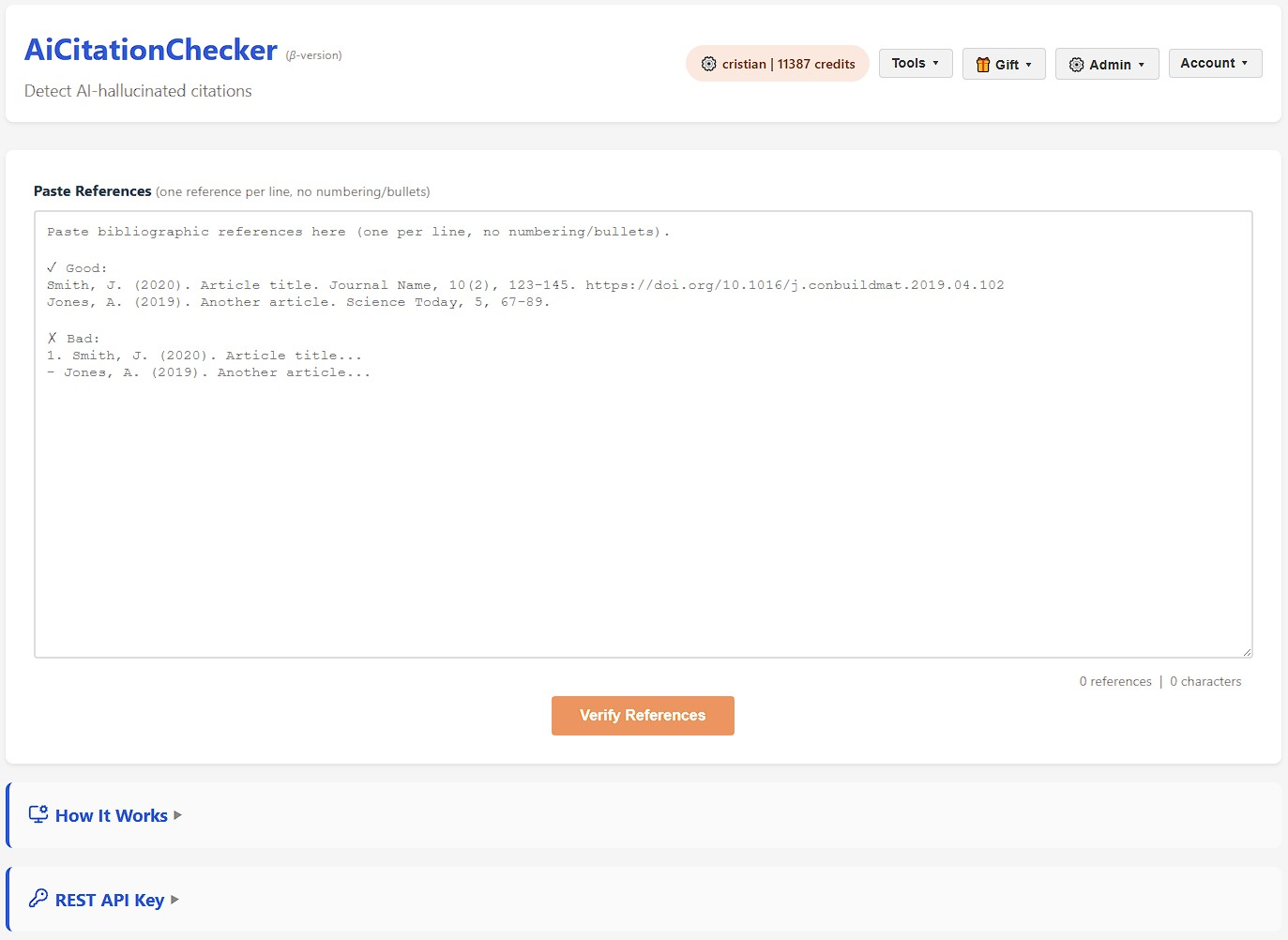
Drop in any bibliography — APA, IEEE, Vancouver, Chicago, Harvard, MDPI, ACS, Wiley/AMA, or numbered/bulleted lists exported from Word, Mendeley, Zotero, EndNote, or straight from a journal article. The tool auto-strips numbering, bullets, and "View / Web of Science®" footer noise. One reference per line, or paste a whole References chapter — the format detector handles both, and shows you the cleaned split and the credit estimate before anything is verified.
2. Every Entry Is Checked Against the Databases
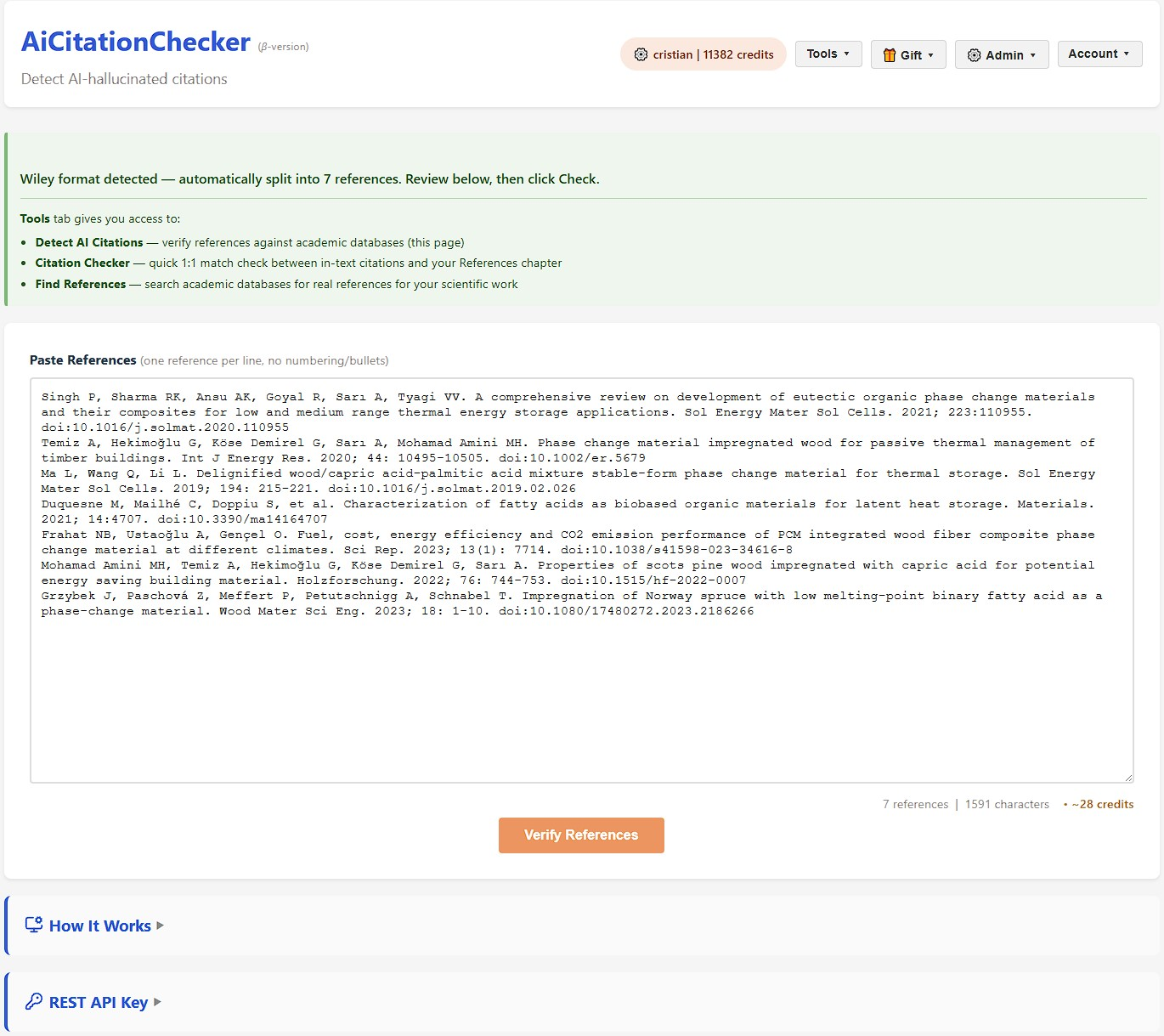
Each reference is matched against CrossRef, OpenAlex, and Semantic Scholar — by DOI where one is present, and by title, author, and year where it is not. The matcher tolerates truncated titles, initials, multi-author groups, and formatting differences, so a real paper is recognised even when the citation is untidy. Nothing is verified until you click — review the split first.
3. Get a Verdict on Every Reference
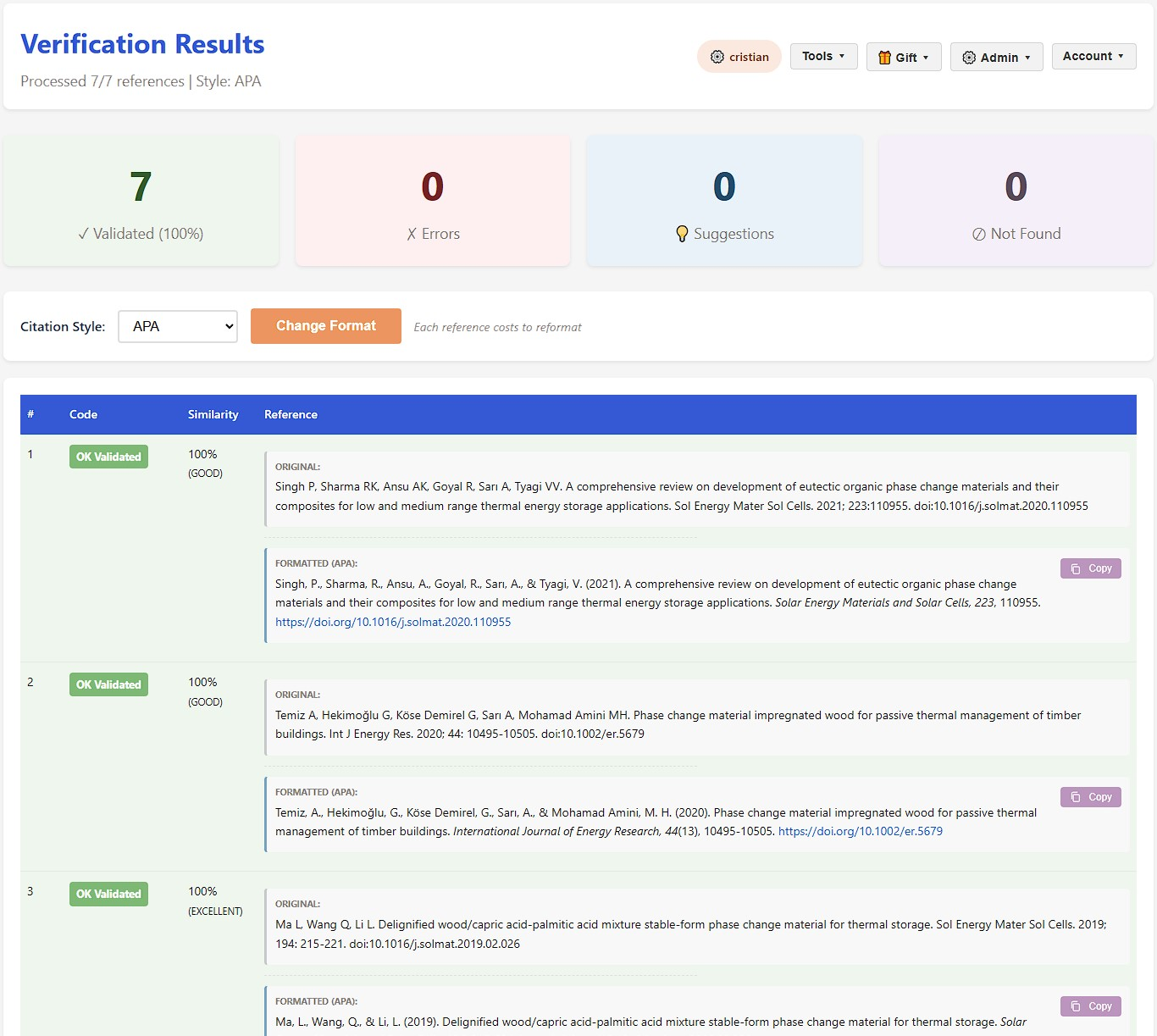
Each reference returns a status — Validated, Suggestion, Error, or Not Found — with a similarity score against the matched record and a side-by-side view: your version on top, the authoritative version below. Where the correct paper is identifiable, the tool reformats the citation cleanly in your chosen style (APA, IEEE, Chicago, Harvard, Vancouver, or MDPI) and lets you export the whole verified list as a Word document.
What the Citation Checker Catches
- Fabricated papers — a plausible-looking reference for an article that was never published; no record in any database.
- Fabricated or mismatched DOIs — a well-formatted DOI that resolves to a different article, or to nothing at all.
- Wrong or altered authors — the title and journal are real, but the author list was changed (a common AI edit) so the citation misattributes the work.
- Wrong journal, year, or volume — each field checked against the authoritative record and flagged individually, so you know exactly what is off.
- Real paper, garbled citation — the work exists but your entry is transcribed incorrectly; the tool surfaces the clean version to copy.
- Not found — an honest "we could not confirm this" for sources outside the databases' coverage, kept clearly distinct from "this is fabricated."
Reference Formats Supported
The checker reads author–year and numbered reference systems, detecting the format automatically:
APA · Harvard · Chicago · IEEE · Vancouver · MDPI · ACS · AMA / Wiley
Mixed-style bibliographies (a common artefact of merged sections or collaborative writing) are handled — each reference is parsed and verified independently.
See a Real Verification — Try It With These References
Below are three real references from the literature on citation accuracy — the same studies quoted above. Paste them as a reference list to see the checker confirm each one against the databases.
Copy the block below, paste it at the Citation Checker, and click Verify. Each entry is matched against CrossRef, OpenAlex, and Semantic Scholar — comfortably within the free daily allowance for a short list like this.
DeLacey, G., Record, C., & Wade, J. (1985). How accurate are quotations and references in medical journals? British Medical Journal, 291, 884–886.
Eichorn, P., & Yankauer, A. (1987). Do authors check their references? American Journal of Public Health, 77, 1011–1012.
Evans, J. T., Nadjari, H. I., & Burchell, S. A. (1990). Quotational and reference accuracy in surgical journals. JAMA, 263, 1353–1354.
All three are genuine and should come back confirmed. To see the checker catch a bad citation, change a DOI digit, a year, or an author's surname before you paste — that entry will be flagged.
Who Uses the Citation Checker
Authors before submission
Verify every reference in the bibliography before sending to the journal. A clean check takes minutes; a reviewer catching a fabricated citation costs weeks — and credibility.
Peer reviewers
Confirm a manuscript's references are real and correctly cited at the start of review. Objective, documented findings — not impressions.
Thesis supervisors
Check a dissertation's bibliography before the defence. A non-existent reference is an objective fact, not an editorial opinion.
Journal editors
First-pass screening at intake. Flag fabricated or mis-described references before the manuscript reaches a reviewer's desk.
Researchers using AI tools
If ChatGPT, Claude, or Gemini touched your draft, verify the bibliography before you trust it. Injected citations look perfect and often are not.
Research assistants
Audit literature reviews and systematic reviews for citations that do not resolve. Every problem entry documented automatically.
Free to Start. Priced for What It Saves.
Manually verifying a 30–50 reference bibliography takes 1–2 hours. At any academic hourly rate, the tool pays for itself on the first use. References with a DOI cost 1 credit each to verify; those resolved by title search cost 2.75. The live estimate shows the exact cost before you commit.
Free — $0
Daily credit allowance — enough to verify a typical reference list. Refreshed every day. No credit card, no subscription.
Silver — $9.99
90 days of access + 2,500 credits. One-time purchase, no auto-renewal. Covers dozens of full bibliographies.
Gold — $19.99
180 days of access + 6,000 credits. For sustained high-volume use.
Related Tools
Detect AI Citations →
The same verification, focused on AI-generated bibliographies — ChatGPT, Claude, and Gemini hallucinations, fabricated DOIs, and invented papers.
Match Citations to References →
A different job: checks that every in-text citation has a matching entry in your reference list, and every reference is actually cited — internal consistency, not whether the works are real.
Find References →
The inverse — paste a claim or paragraph and get back real, citable papers that directly support it. For when you need references, not when you need to verify them.
Minutes to know every citation is real.
Free account. No credit card. Every reference checked against the databases.
Start Checking Citations